How to Play Grail
The rules the tutorial compresses into a few tooltips.
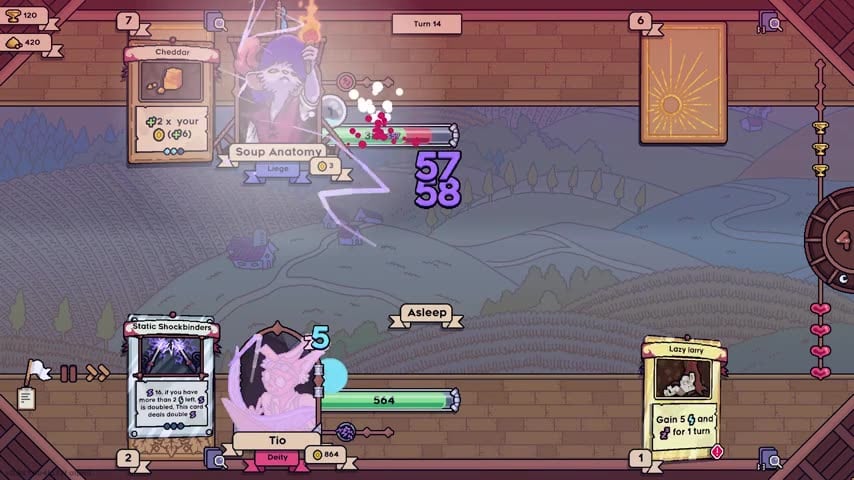
Grail looks like a card battler and plays like a puzzle you solve in the woods. Combat is automatic. You still need to know the rules, because every shop purchase is a bet on how those rules will replay. This page is the ruleset. For a first-hour checklist use getting started. For pip math use energy and cards.
The battlefield
Each side has a health bar, a deck, a discard, an energy pool, and a portrait. Gold and trophies sit in the corner of the overworld, not inside the duel. During a fight you will see:
- Turn number at the top (for example, Turn 11 or Turn 14).
- Energy as a gem and as pips on the card that just drew.
- Played cards sliding into the lane with damage numbers.
- Status icons on portraits (bleed, poison, burn, shock, and others).
- Deck and discard counts that matter for cards such as Lance, which scales with cards in the opponent’s draw and discard.
The player with more cards in the deck typically starts. That one sentence is why “just add every rare” is a trap: you might win initiative and then fail to play anything because your energy is spread across too many expensive cards.
A single turn
- Draw one card.
- Give it one energy from your pool.
- If that card’s pips are now full, it plays and spends those pips.
- If not, the card stays in play waiting for more energy on a later visit.
- After a turn that involved a draw, you gain one energy back toward the pool (you start fights with four).
There is no “choose a target” step. There is no “hold this card.” If a card has a condition — “if you have more than one energy,” “when this is fully energized, play immediately,” “deal double if doubled” — the game evaluates it when the card actually resolves. Guardbot is the poster child: it buffs your other cards and can fire the instant it fills. Static Shockbinders cares about your current energy and doubling. Lazy larry prints gold on a timer. Read the text once in the cardopedia, then trust the auto-resolver.
Why fights speed up
Decks reshuffle when they empty. Each reshuffle makes the next cycle faster, which is both a juice thing and a balance thing: infinite stall decks still hit the 40-turn wall where both sides start losing health. If your win condition is “poison them on the third shuffle,” you need to survive until that shuffle. If your win condition is a fat burst on the first cycle, you want a thin deck and enough energy to actually play the burst.
Poison in Grail is not “damage per turn” from other games. It triggers on shuffle, hits harder against shields, and can also fire when a player has nothing left in discard. Bleed triggers whenever the victim takes any damage, then ticks down. Burn cares about discards. Shock cares about energy gain. Put those four sentences on a sticky note; the status effects page expands each one with card examples.
Between fights: the actual game
After a battle you return to the river. You pick a node, pay its gold if it has a banner price, and collect a card, trait, upgrade, or event. Events can be as weird as “buy a mushroom from a stranger and gain a trait that costs 8 or more, or skip.” Skipping is a real choice. Taking every event is how you arrive at the player battle on 200 HP with a deck that does not match itself.
You may inspect your deck at any time. You may sell cards at any time. You may hold a trait to remove it. Those three actions are how you correct a bad morning. They are also why the run planner exists: decide before the node whether you need gold, health, or a thinner deck.
Player battles versus monster battles
Monsters and scripted enemies teach you the current build. Player battles at the end of the day are the scoreboard. You need six of those wins. Four losses end the run. Matching is asynchronous — you are fighting a snapshot of someone else’s deck, including people who continued a run you have not reached yet (1.0 reduced some of those unfair pairings). See PvP battles for how to read an opponent’s energy curve in the first five turns.
Day 10 is special in 1.0: a final boss plus good and bad endings, with Iconic cards and secret events feeding the lore. Do not skip how to win a run if you keep dying on days 6–8.
Card types you will actually use
You do not need the full cardopedia on day one. You need buckets:
- Attacks — Jab, Bayonet, Stilettos (“27 twice”), Lance.
- Food / heals — Apple, cheese line, Guda-style heals that also strip status.
- Status applicators — Toothpick (bleed), Poison tip, Cheddar-style multipliers, Copper wire (shock).
- Engine cards — things that refund energy, play themselves, or scale each cycle.
- Iconic — character legends such as Rapier of the Rat, Carrot roast dinner, Johanna’s prosthetic.
Rarity is not power. A common one-pip that you replay four times beats a four-pip rare you never fill. Rankings live on the card tier list. Character pools differ; do not buy a Zappy card plan on a Ratagnan save. Confirm the kit on the characters hub.
Traits in one paragraph
Traits are passives. You can hold three. You can remove one by holding it. They come from shops, events, and monster pools. Insulated and Antifragile arrived in 1.0. Scutate is a shield trait. Enemy example: Unstable. If a trait does not name a card type you already own, skip it. The trait tier list and synergy checklist exist so you stop treating traits like slot-machine stickers.
What “playing well” looks like
A good Grail player watches the first cycle, then changes the deck. If Apple is the only card that plays, you are energy-starved. If you kill on cycle one, you can afford a greedy shop. If the opponent is stacking poison, you need shuffle speed or a cleanse, not another bleed applicator. That is the whole skill. The video above is a long demo run that shows the loop in real time; pause it whenever a card sits unplayed and ask why the pips were empty.
When you can explain a loss in one sentence, you are ready for upgrades and enchantments and the starter builds page.
Frequently Asked Questions
Quick answers to the most common questions.
Do I click cards during a fight?
No. You draw, energy is applied, and the card plays if its pips are full. All choices happen on the map and in menus.
Who goes first?
Usually the fighter with more cards in the deck. Fat decks win initiative and then often fail to spend energy.
Why did my fight suddenly deal damage to both of us?
After about 40 turns both sides lose health so duels cannot last forever. Faster reshuffles also speed the remaining turns.
How many traits can I hold?
Three. Hold a trait to remove it if it no longer matches the deck.
Where are the full status rules?
On the status effects guide. Bleed, poison, burn, and shock each trigger on a different game action.